The Limits of Artificial Intelligence in Cinema: China’s First Fully AI-Generated Feature Film Flops at the Box Office

The global entertainment industry has reached a critical juncture in its adoption of artificial intelligence, but consumer appetite for fully synthetic media remains sharply divided. While audiences across Asia and Western markets have readily embraced generative AI for fast-paced, bite-sized digital content, the transition of this technology to the big screen has encountered a formidable roadblock. In China, the commercial and critical failure of the nation’s first fully AI-generated feature film has signaled a profound hesitation among moviegoers when it comes to feature-length synthetic storytelling.
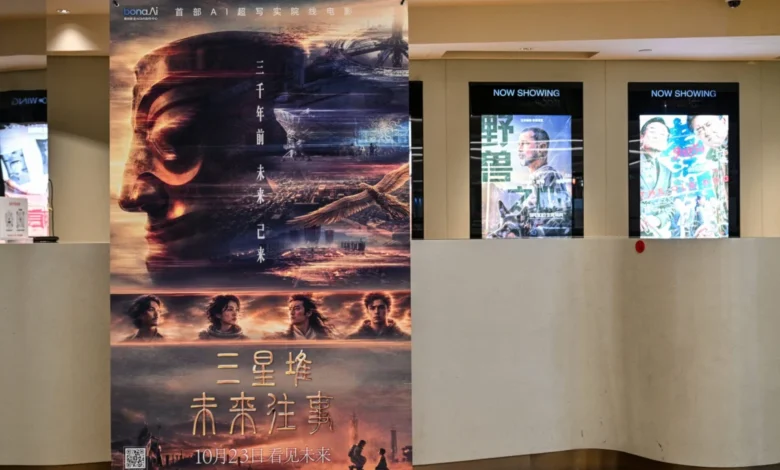
The sci-fi thriller Sanxingdui: Future Past, produced by the prominent Chinese studio Bona Film Group, arrived in cinemas with considerable industry anticipation as a historic milestone. Based on state media reports, the narrative follows an archaeologist tasked with liberating a future society enslaved by artificial intelligence—a thematic irony given the production methods behind the film itself. Yet, despite holding a theatrical release permit and pioneering a new frontier for cinematic production, the film collapsed at the box office. According to data from ticketing platform Maoyan, the movie grossed a meager $180,000 through its opening Monday run. This figure stands in stark contrast to its reported production budget of $1.5 million, marking a substantial financial loss for its backers and setting a cautionary precedent for studios eyeing similar technological shortcuts.
Breaking New Ground Versus Meeting Audience Demands
The stark underperformance of Sanxingdui: Future Past prompted a measured defense from studio executives. Jiang Defu, chief operating officer of Bona Film Group, addressed the lukewarm reception in an interview with domestic film outlet Yuli. While acknowledging the commercial shortfall, Jiang framed the project as a vital, pioneering experiment for the broader film industry.
"We are the first to try it, the first to get a theatrical release permit, and the first to be tested by the audience," Jiang remarked, emphasizing the logistical and regulatory hurdles cleared by the production team. "I think that is not easy at all."
Despite these executive justifications, the public response on social media platforms highlighted a deep rift in consumer perception. On Xiaohongshu—a popular Chinese lifestyle and social media network—reactions ranged from amused fascination to outright dismay. One user bluntly posted that "China’s first AI movie totally traumatized me," pointing to the unsettling visual aesthetics frequently associated with early-stage generative video models. Conversely, other internet commentators adopted an optimistic view regarding the creative democratization afforded by the technology, with one user observing that the primary takeaway of the experiment was the ultra-low cost and total creative freedom enabled by AI tools.
The Microdrama Revolution and the Dichotomy of Content Length
The rejection of Sanxingdui in traditional cinemas highlights a fascinating paradox in modern media consumption: audiences are remarkably receptive to AI-generated content in short formats, yet fiercely protective of the theatrical feature-length experience.
This dichotomy is most clearly demonstrated in the explosive growth of China’s microdrama market. These ultra-short narratives, tailored specifically for mobile consumption on platforms akin to TikTok, have been almost entirely overtaken by generative artificial intelligence. Market data compiled by financial publication Caixin reveals that over 95% of the more than 120,000 Chinese microdramas released during the first quarter of 2026 were generated using AI technologies—a staggering leap from virtually zero market share just twelve months prior. Concurrently, the economic barriers to entry for digital storytelling have completely collapsed, with the production costs for individual microdramas plummeting to as little as $3,000.
Yet, this rapid consumer acceptance of synthetic short-form content has not translated to the multiplex. Stanley Rosen, a professor at the University of Southern California who specializes in Chinese film and society, notes that the public remains profoundly skeptical regarding the integration of generative intelligence into major cinematic releases.
"The public is highly skeptical about AI use in major feature films, despite their general acceptance of short-form films," Rosen observed. He further emphasized that financial setbacks of this magnitude will fundamentally alter industry calculations. "The financial loss of Sanxingdui: Future Past will compel others contemplating using AI for feature films to tread more carefully."
Global Industry Tensions: Hollywood, Streaming, and Regulatory Backlash
The friction surrounding AI in filmmaking is by no means isolated to the Chinese market. Across the globe, the entertainment sector has grappled with the ethical, economic, and artistic implications of generative tools. In the United States, these tensions boiled over in 2023 during historic, months-long strikes by the Writers Guild of America (WGA) and SAG-AFTRA, both of which fought successfully to secure stringent contractual protections guarding actors and writers against displacement by artificial intelligence.
Despite these hard-fought labor agreements, major Hollywood studios and prominent filmmakers have quietly integrated AI systems—powered by advanced models developed by technology firms such as ByteDance and Higgsfield AI—into their post-production workflows. A prominent example emerged in October 2026, when Netflix released the crime thriller Animals, directed by Ben Affleck. During a subsequent Bloomberg event, Affleck openly admitted to utilizing artificial intelligence extensively throughout the production process.
"I used [AI] for lots of things in that movie," Affleck stated, though he admitted a degree of hesitation in detailing the exact applications, noting that cinema fundamentally relies on "foster[ing] the illusion of reality."
Unlike theatrical releases, which depend on an upfront ticket-buying public willing to pay premium prices for a shared cultural event, streaming platforms offer a more forgiving environment for technological experimentation. Rosen suggests that fully AI-generated feature-length projects may ultimately find a more viable commercial home on subscription-based video-on-demand services like Netflix or Amazon Prime Video, rather than traditional theatrical windows. Furthermore, Rosen argues that for an AI-generated film to successfully command theatrical audiences, its visual fidelity and narrative sophistication would need to rival established, blockbuster-tier masterpieces such as Avatar or domestic Chinese hits like Nezha 2.
Economic Implications and the Future of Cinematic Labor
As the dust settles on the box office failure of Sanxingdui: Future Past, industry analysts are re-evaluating the trajectory of generative media. The economic promise of AI—specifically its ability to slash overhead expenses, eliminate traditional pre-production bottlenecks, and democratize visual effects—remains a powerful lure for independent creators and venture capitalists alike. However, the commercial reality laid bare by Maoyan’s tracking data suggests that moviegoers view feature films as a deeply human craft.
The willingness of audiences to accept lower-cost, synthetic content on mobile devices while demanding human authenticity in cinemas points toward a stratified future for the entertainment industry. In this landscape, microdramas and experimental streaming projects may continue to serve as testing grounds for raw artificial intelligence, while traditional theatrical releases will likely double down on human-centric storytelling, star power, and tangible craftsmanship to justify rising ticket prices.
Ultimately, the box office collapse of China’s inaugural AI feature serves as a stark reminder that technological capability does not automatically equate to market demand. While production studios will undoubtedly continue to refine and utilize generative tools behind the scenes to optimize workflows and reduce expenditures, Sanxingdui: Future Past demonstrates that audiences are not yet willing to trade the soul of the cinema experience for algorithms. Studios worldwide are taking notice, and the race to integrate artificial intelligence into feature films is slowing down to a much more cautious, deliberate pace.
Related posts: